The signs of the institute
Emblem, Flag and Trophy
Three signs carry the same trinity of ivory, gold and sienna — that of the three pillars of We-ism.
The symbol of We-ism
The Doctrinal Emblem
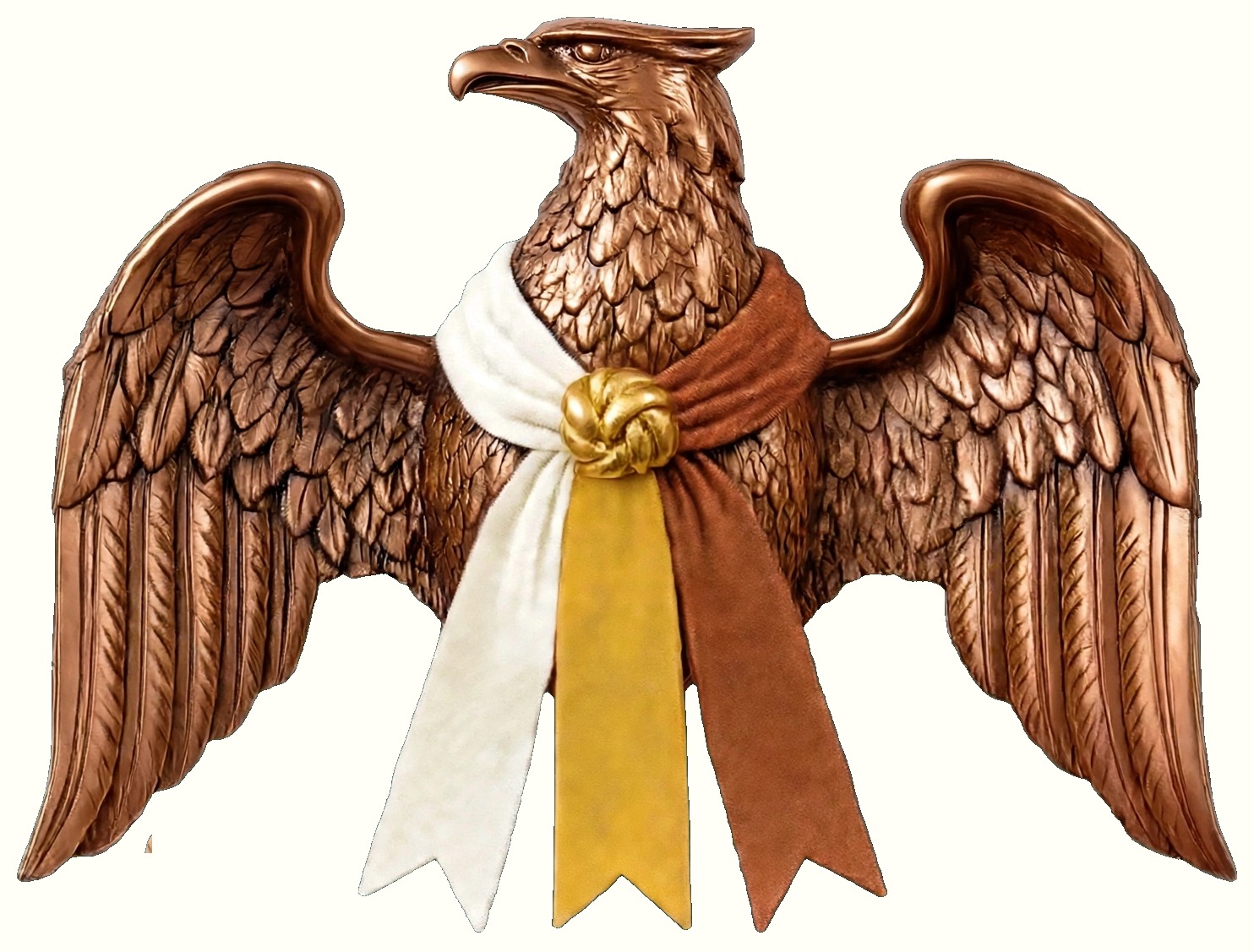
The Eagle with Three Fabrics: such is the emblem of the doctrine of We-ism — to be distinguished from the Tuzafrika logo, which identifies the institute. It combines the protective majesty of the bronze Eagle with the fraternity embodied in the three knotted fabrics.
The Eagle symbolises destiny sovereignty, the elevated vision that rises above individual fractures, and the protection of a collective destiny. It does not dominate with its talons: it bears on its breast the sacred knot of sister nations and watches over their alliance. Of coppered bronze, a living and ancient metal, polished like a statue that crosses the centuries — it embodies resilience, memory that acquires a patina without being corrupted. At the centre, the golden knot seals the junction of the three fabrics — the hearth of the Heart/Conscience, the suture point where histories intersect to become a community of destiny.
This emblem was born of a geography: that of Lake Kivu and the Great Lakes, where three sister nations — the Democratic Republic of the Congo, Rwanda and Burundi — face and touch one another, bound by waters, languages, families and history, in pain as in hope.
Each fabric carries a shore; the golden knot carries their common destiny. What politics has torn apart, We-ism proposes to tie together again — not through forgetting, but through the patient art of the bond: truth, justice, then embrace.
- The ivory fabric — the Knot of Destinies
- The gold fabric — Useful-Existence
- The sienna fabric — Awakened Service
Unlike closed structures, the three fabrics, though firmly bound at their centre by a common destiny, fall freely at their base, free of any foreign piece or circular constraint. This lower opening teaches a major truth: unity is not confinement. While the central knot guarantees the indissoluble solidarity of a common destiny, the freedom of the ends preserves the sovereignty, the breathing space and the proper autonomy of each people and each nation.
The second sign
The Institutional Flag
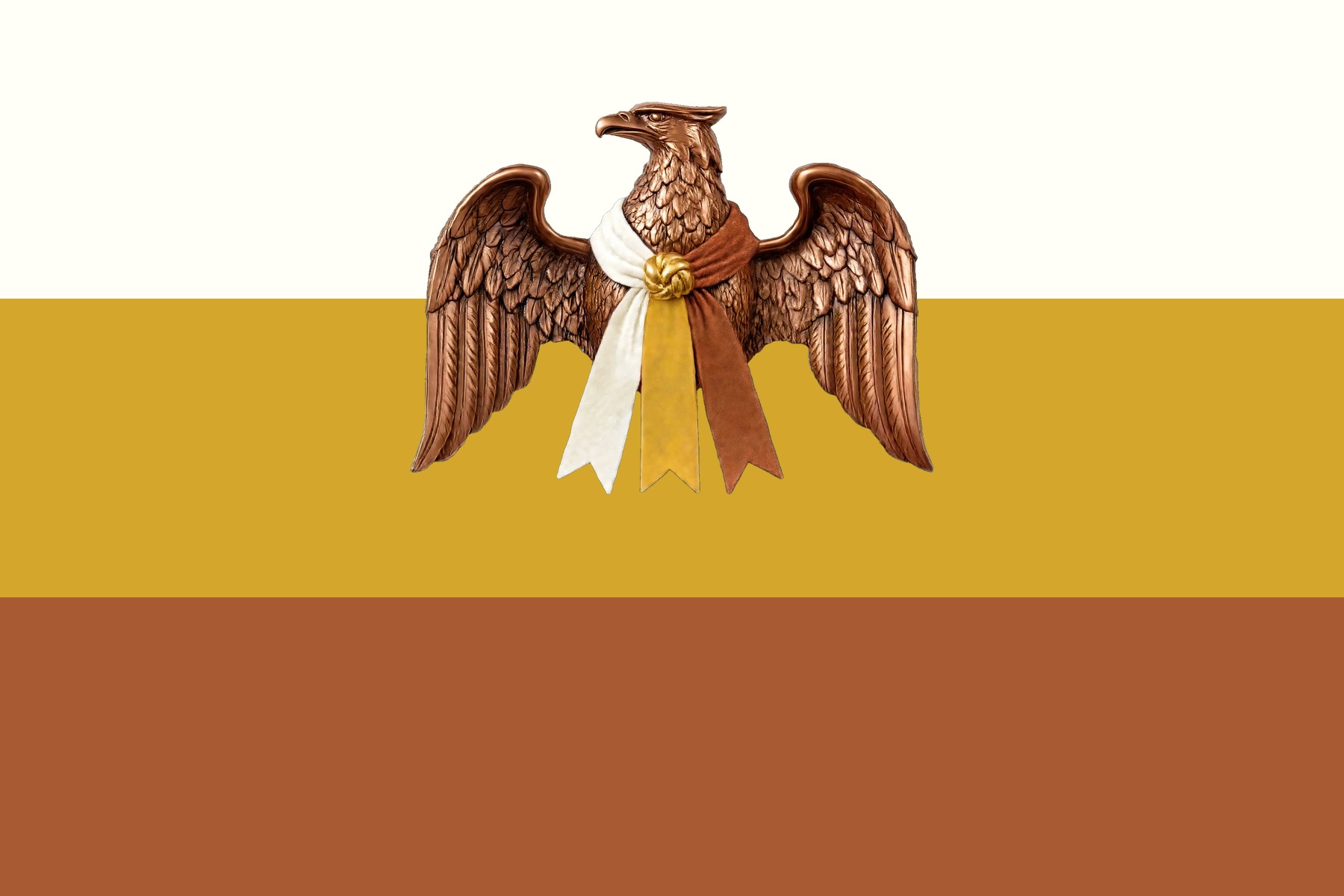
Where the Emblem is worn as a seal, the Flag unfurls as a field. Three equal bands, ivory, gold and sienna, each occupying exactly one third of the surface: no band serves as a base for the other two, for no pillar takes precedence over another. The Eagle with Three Fabrics stands not at the centre, but at the border of the ivory and the gold, one foot on each shore, refusing to rest entirely on a single pillar: it recalls that Useful-Existence grows only from the soil of the Knot of Destinies, never separately from it.
- The ivory fabric — upper band, the Knot of Destinies
- The gold fabric — middle band, Useful-Existence
- The sienna fabric — lower band, Awakened Service
Thus flies, without hierarchy or ornament, the same trinity that the Eagle bears on its breast.
The third sign
The Trophy of the Living Landmark
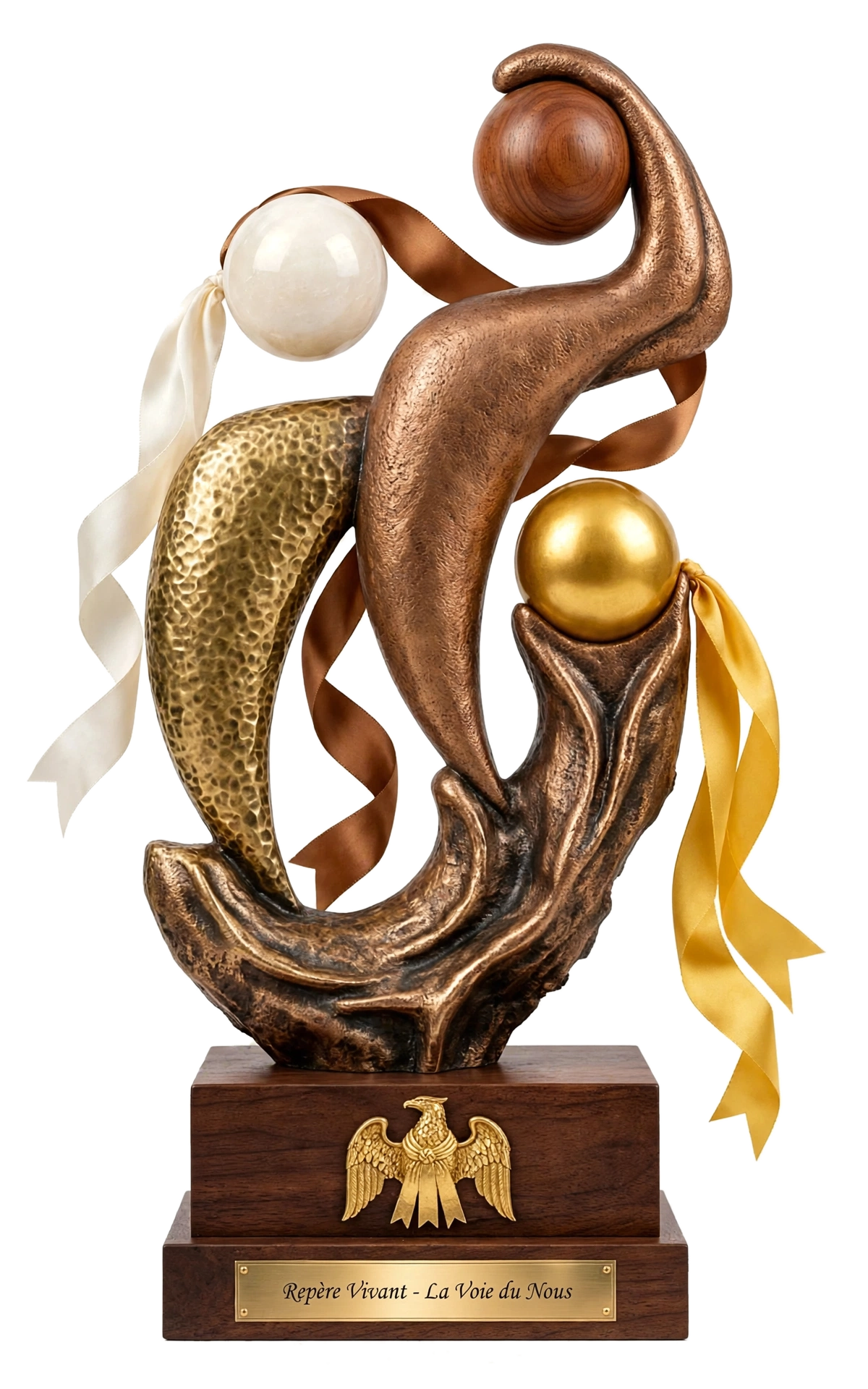
There is one sign the institute does not display for itself, but bestows: the Trophy of the Living Landmark. Where the Emblem and the Flag unfold on a surface, the Trophy is knotted in volume — a single torsion of bronze, the Heart/Conscience in continuous movement, bearing three spheres, each linked to the ribbon of its own colour: the ivory nacre of the Knot of Destinies, the sienna wood of Awakened Service, the gold of Useful-Existence.
Its base bears, engraved, the Eagle with Three Fabrics, and a plaque that knows only one name: Living Landmark. This trophy is never bestowed for the mere signing of the Charter; it is bestowed only when the constancy of deeds, verified by peers, has turned the promise into lived evidence.